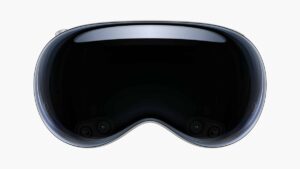
Apple has officially abandoned development of a cheaper, lighter Vision Pro, with Samsung Display set to formally terminate the G-VR display project by September 2026. The panel, a glass-substrate micro-OLED designed to cut costs and weight compared to the current Vision Pro’s silicon-based OLEDoS, is being internally wound down at Samsung after Apple suspended work on the headset it was built for.

The G-VR was conceived as a lower-resolution alternative to the Vision Pro’s 3,386 pixels per inch, targeting around 1,600 to 1,700 PPI. Mass production had been planned for sometime after 2028. But that timeline is now defunct. This marks the end of what was once positioned as Apple’s path to mainstream spatial computing: a cheaper, more accessible headset that could broaden Vision Pro’s appeal beyond early adopters and professionals willing to pay $3,699 for a niche device.
The formal cancellation follows months of reporting that Apple had deprioritized the budget headset in favor of smart glasses. In October 2025, Mark Gurman reported that Apple had paused work on the “Vision Air,” a lighter, cheaper model, to fast-track glasses that would compete with Meta’s Ray-Bans. By May 2026, Gurman confirmed the cheaper device had been canceled outright. Supply chain analyst Ming-Chi Kuo reported this month that incoming CEO John Ternus signed off on canceling both a second Vision Pro and the Vision Air, redirecting resources toward smart glasses development, which Apple now aims to launch in late 2027.
The irony cuts deeper with Apple’s June 2026 price hike: the Vision Pro’s starting price rose from $3,499 to $3,699, the same month reporting confirmed the cheaper alternative was dead. No cheaper option exists now or will for years. For a product already priced seven times higher than Meta’s Quest 3 and holding roughly 5 percent of the XR market, that increase signals Apple has written off volume growth entirely. Vision Pro now exists as a niche, high-margin product for those already committed to the ecosystem.
Existing Vision Pro owners should take note: with the team scattered and no successor planned for at least two more years, Apple’s momentum behind the category has stalled. Already the company is reportedly discontinuing the Vision Pro Travel Case. If Apple’s last two years with Vision Pro taught the company anything, it’s that spatial computing at consumer scale is harder than expected. The company is betting that smart glasses, not headsets, will be the winning form factor, and it’s committing resources to that belief.