M5 Pro vs M5 Max is the main choice on the MacBook Pro with PROLED XDR Display, and the price gap is $1,600 on the 14-inch MacBook Pro and $1,400 on the 16-inch MacBook Pro. Both chips are the ones Apple shipped in the March MacBook Pro models, so the decision comes down to cores, memory and external displays.
Touch, the Dynamic Island and the PROLED XDR display come with either chip, and the touchscreen MacBook Pro announcement has the full price list. Chip figures below are Apple’s March specs for the same chips.

M5 Pro vs M5 Max starts $1,300 to $1,600 apart
| Model | M5 Pro | M5 Max | Difference |
|---|---|---|---|
| 14-inch MacBook Pro | $2,899 | $4,499 | $1,600 |
| 16-inch MacBook Pro | $3,399 | $4,799 | $1,400 |
| 14-inch MacBook Pro, education | $2,749 | $4,199 | $1,450 |
| 16-inch MacBook Pro, education | $3,199 | $4,499 | $1,300 |
These are starting prices for each chip, and higher-core versions are configurable. The 16-inch MacBook Pro narrows the gap by $200 at standard pricing, so the premium for M5 Max is smaller on the larger screen. Education pricing keeps the gap at $1,450 on the 14-inch MacBook Pro and $1,300 on the 16-inch MacBook Pro.
M5 Max doubles the GPU cores and raises memory bandwidth
| Spec | M5 Pro, 14-inch base | M5 Pro, 16-inch | M5 Max |
|---|---|---|---|
| CPU cores | 15 (5 super, 10 performance) | 18 (6 super, 12 performance) | 18 (6 super, 12 performance) |
| GPU cores | 16, or 20 as an upgrade | 20 | 32, or 40 as an upgrade |
| Memory bandwidth | 307GB/s | 307GB/s | 460GB/s, or 614GB/s with 40 GPU cores |
| Memory options | 24GB or 48GB, up to 64GB with 20 GPU cores | 24GB, 48GB or 64GB | 36GB, or 48GB, 64GB and 128GB with 40 GPU cores |
| Video encode engines | One | One | Two |
The 14-inch MacBook Pro starts M5 Pro at a 15-core CPU, while the 16-inch MacBook Pro starts it at the 18-core CPU that M5 Max also uses. Both chips have a 16-core Neural Engine, and each GPU core carries a Neural Accelerator, so the 32-core GPU in M5 Max has twice as many as the 16-core GPU in M5 Pro.
The second video encode engine, along with a second ProRes engine, is what video editors get for the extra money. Both chips share the same Media Engine formats, including H.264, HEVC, ProRes, ProRes RAW and AV1 decode, so codec support is not a reason to choose either.
Storage and displays split the two chips
The March M5 Pro models offer 1TB to 4TB of storage and the M5 Max models 2TB to 8TB. The touchscreen model is configurable up to 16TB, and Apple gives no breakdown by chip.
Memory is the clearer split, with M5 Pro topping out at 64GB and M5 Max reaching 128GB, the figure that matters for running large AI models on the device. For external displays, M5 Pro supports up to three over a single Thunderbolt 5 port and M5 Max supports up to four, in addition to the built-in screen. Anyone running a multi-monitor desk should count displays before choosing a chip.
Apple points M5 Max at VFX, AI and film scoring
Apple positions M5 Pro for scientists, engineers, developers and creative pros who compile code, run AI tasks or edit multiple streams of 8K ProRes video. M5 Max is aimed at 3D VFX artists, AI developers and film composers, including running large language models with hundreds of billions of parameters on the device.
I would start with M5 Pro unless your work is bound by GPU rendering, memory or four external displays. The extra $1,300 to $1,600 buys GPU cores, memory and display support, and the redesigned thermal architecture holds the same sustained performance of both chips in the lighter body.
March battery ratings run two hours lower on M5 Max
The March 14-inch MacBook Pro lists up to 22 hours of video streaming with M5 Pro and 20 hours with M5 Max, and the 16-inch MacBook Pro lists 24 hours and 22 hours. The touchscreen model’s announcement gives only an up to 24 hours headline, so per-chip figures for it are still to come.
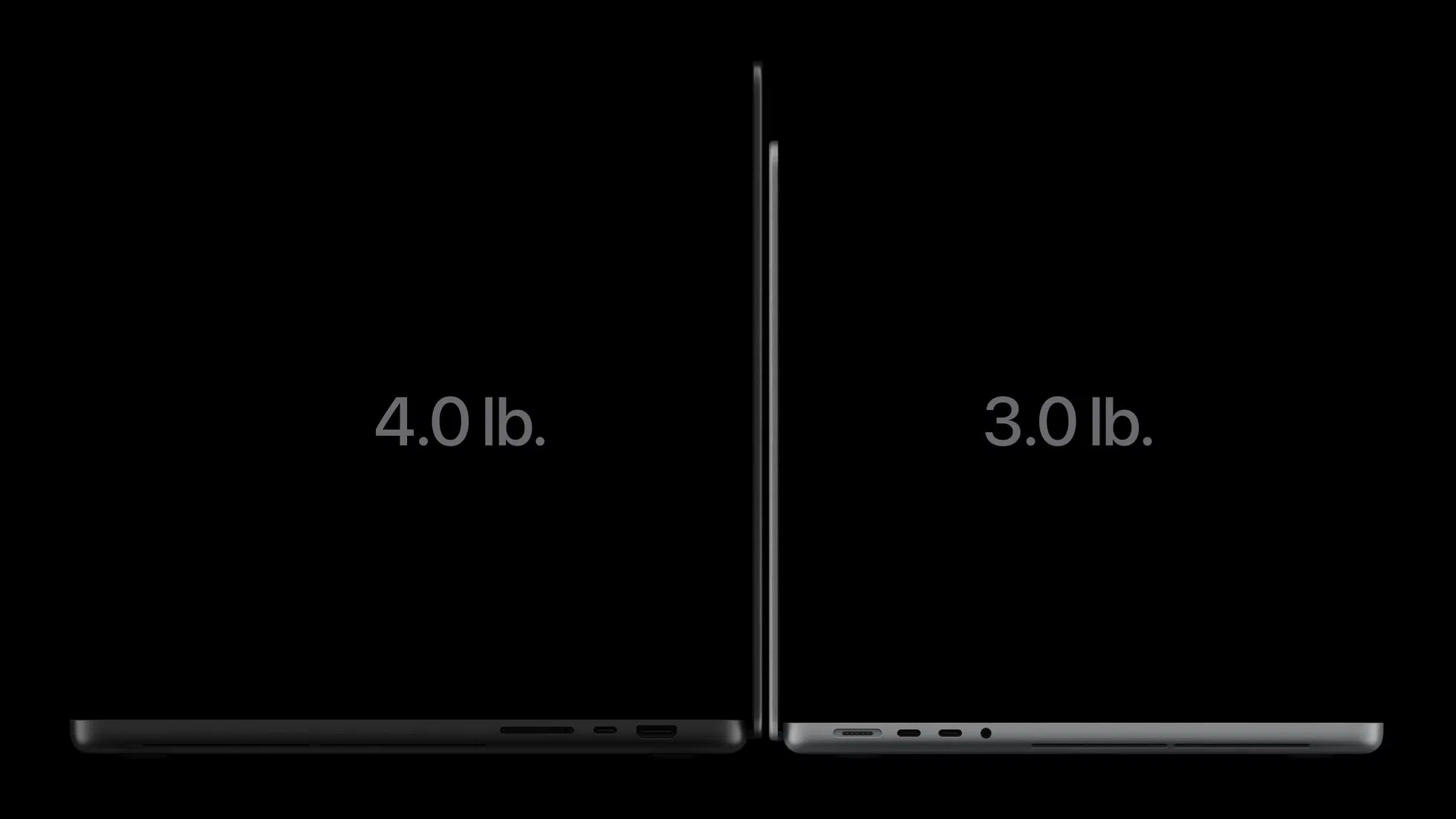
Weight is the other trade-off, with the new 14-inch MacBook Pro half a pound lighter than before at 3 pounds and the new 16-inch MacBook Pro 0.7 pounds lighter at 4 pounds. That narrows the portability gap between the two sizes. Pre-orders opened October 28 and the first units arrive Friday, November 6.




1 comment