The touchscreen MacBook Pro is Apple’s MacBook Pro with PROLED XDR Display, announced October 28 with a tandem OLED touch display, the Dynamic Island and a lighter body. Pre-orders opened the same day, and the first units arrive Friday, November 6. Both sizes keep the M5 Pro and M5 Max chips from the March MacBook Pro models.
Touchscreen MacBook Pro starts at $2,899
The 14-inch MacBook Pro with M5 Pro starts at $2,899 and the 16-inch MacBook Pro with M5 Pro at $3,399. M5 Max versions start at $4,499 for the 14-inch MacBook Pro and $4,799 for the 16-inch MacBook Pro, and education pricing takes $150 to $300 off.
The Apple Upgrade lease starts at $55.99 a month for 36 months on the 14-inch MacBook Pro with M5 Pro, while Apple Card Monthly Installments run 12 months at 0 percent APR. Picking a configuration is easier with our pre-order guide, which starts from the 14-inch MacBook Pro with M5 Pro for most buyers.
Cheaper routes exist if you skip touch, since the 14-inch MacBook Pro with M6 starts at $1,999 and the 13-inch iPad Pro at $1,499. The iPad Pro comparison comes down to Apple Pencil, which works only with the iPad Pro.
The touchscreen MacBook Pro display peaks at 2000 nits
The PROLED XDR display reaches 2000 nits peak, up from 1600 nits on Liquid Retina XDR, with a 10,000,000:1 contrast ratio and P3 plus Adobe RGB color. Full-screen sustained brightness stays at up to 1000 nits.
The touch sensor sits inside the panel, and a redesigned hinge keeps the screen steady when you tap. macOS turns touches into clicks, so many existing apps work on day one, and 14 named apps add touch later this year. The macOS 27.2 betas had already added touch gesture code before launch.
Apple’s reasons for adding touch came after a decade of leaving it off. The nano-texture option is now etched into the cover glass, and both sizes come in silver and black finishes.
Dynamic Island takes Spotlight and Live Activities
The Dynamic Island is the new home for Spotlight, Live Activities and Siri AI on the Mac, and it can take a call, control music or accept an AirDrop request. Spotlight moves there only when Siri AI is available and turned on.
Code in macOS 27 had already included five Dynamic Island views for AirPods, Focus and other system alerts. Apple has not said where the Dynamic Island sits or how large it is.
M5 Max costs $1,400 to $1,600 more than M5 Pro
M5 Max models start $1,400 to $1,600 above M5 Pro, with a 32-core GPU as standard and a 40-core GPU as an upgrade. They also reach 128GB of memory and 16TB of storage, and drive four external displays against three on M5 Pro. Maxing out both puts the fully specced 16-inch build at $14,549. On the 16-inch M5 Max, 16TB costs $7,000 more than the base 2TB, and on the 14-inch, 128GB of memory costs $2,000 more than the 48GB the 40-core GPU starts with.
M5 Pro tops out at 64GB of memory and 4TB of storage, and 48GB costs $600 more than the base 24GB on the 14-inch. M5 Max has two video encode engines, where M5 Pro has one, and the next chips are reportedly M7 in late 2027.
Apple points M5 Pro at scientists, engineers, developers and creative pros who edit multiple streams of 8K ProRes video, and M5 Max at 3D VFX artists, AI developers and film composers. M5 Max can also run large language models with hundreds of billions of parameters on the device.
Battery and weight vary by chip and size
Battery life is up to 22 hours of video streaming on the 14-inch MacBook Pro with M5 Pro and 20 hours with M5 Max. The 16-inch MacBook Pro with M5 Pro reaches up to 24 hours, and the 16-inch MacBook Pro with M5 Max reaches 22 hours.
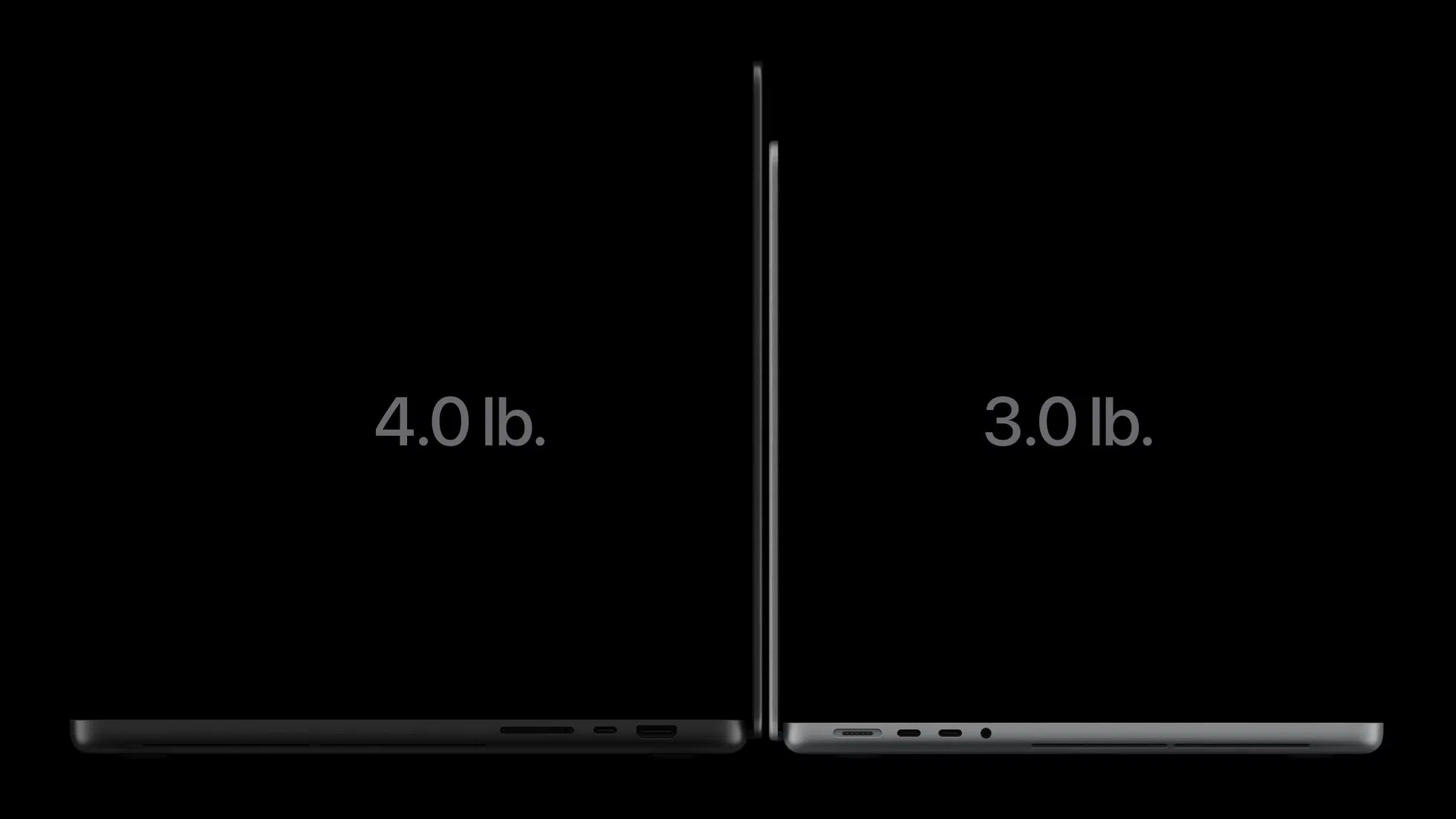
The 14-inch MacBook Pro weighs 3.0 pounds with M5 Pro and 3.1 pounds with M5 Max, and the 16-inch MacBook Pro weighs 4 pounds with M5 Pro. The base 14-inch box ships a 70W adapter that cannot fast-charge, and a 96W adapter costs $79 separately, one of the touchscreen MacBook Pro details missing from the announcement.


