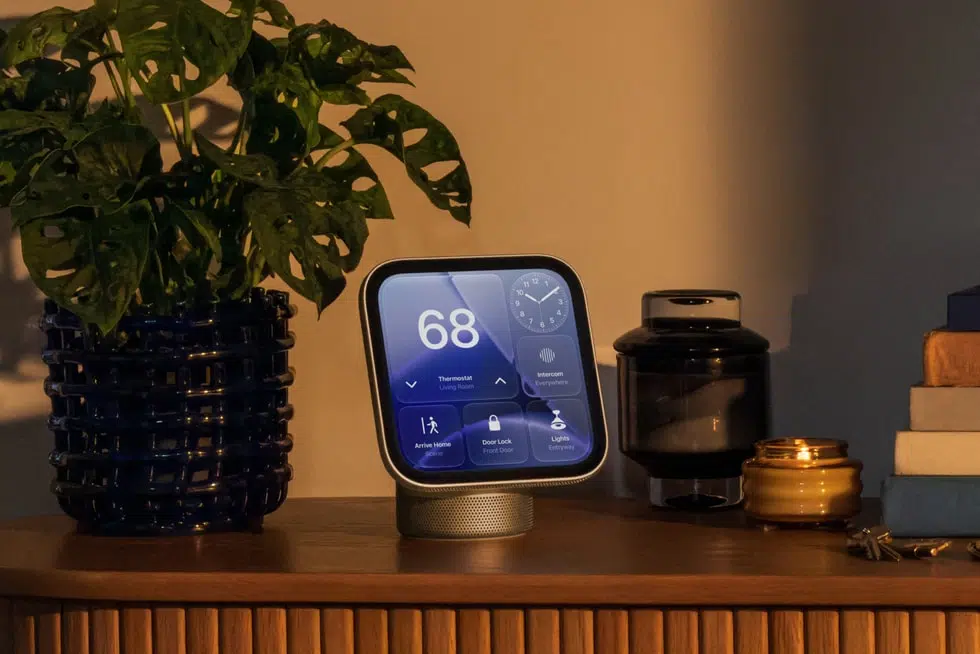
A new Apple patent application describes a touchscreen that turns toward you as you approach, similar to what Apple’s reported HomeView Ultra robot would do. The device also lowers its speaker volume at the same time, since Apple moves power from the speakers to the motors that turn the screen.
Patentlyze spotted the published application, which Apple filed on April 25, 2026 and the US Patent and Trademark Office published on November 5.

The Apple Patent Turns the Screen Toward You as the Volume Drops
A sensor in the device, such as a near-field or ambient light sensor, detects that you are walking up to it. The device then lowers the volume of whatever it is playing, and Apple also lists pausing the audio as an option.
Motors tilt the touchscreen toward your face or your hand. The screen can follow the estimated path of your hand as it reaches out, so it can be angled for touch before your hand arrives.
If the device recognizes who you are, it uses the screen angle you prefer, and you can change that preference later. Recognition can come from your face, voice, fingerprint or gait, or from a phone or wearable you carry.
The motors are back-drivable, so a tap on the screen could otherwise push it away from you. The device holds the screen in position while you use it, and the volume returns to where it was when you stop interacting.
Power Moves From the Speakers to the Motors
The device sets a power budget for its output. When you approach, it shifts part of that budget from the speakers to the motors, which is why the volume drops. The swap can depend on whether the battery is below a set level or whether the device is plugged in.
The screen brightness can change too, for example to match the light level in the room, and it can change back when the interaction ends.
The HomeView Ultra Is the Closest Match in Apple’s Reported Plans
Apple has not tied the idea to a product and names robots, home systems and entertainment devices as possible examples. The robotic HomeView Ultra is the closest match, since its motorized arm would swivel a 9-inch display toward whoever is speaking.
The $299 HomeView that ships on November 13 can already recognize up to six people by face, but its 7-inch screen can only be manually tilted up or down.