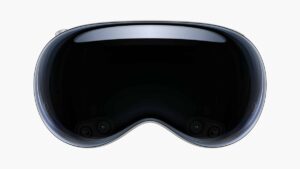
Meta’s new VR glasses and Apple’s Vision Pro solve the same problem in opposite ways. Both companies had to decide how much hardware should actually sit on someone’s face.
Bloomberg broke down the gap between the two devices in a recent look at Apple’s headset plans, and the numbers are stark. Meta’s $1,299 glasses move the processor and battery into a separate module, while Vision Pro keeps everything built into the headset itself.

Meta’s External Puck Cuts Weight To A Sixth Of Vision Pro’s
Meta’s design pulls the heaviest components off the headset entirely, and that single choice explains most of the weight gap. Meta’s glasses come in at roughly one-sixth the weight of Vision Pro, and cost about a third as much.
The trade-off is an extra device to carry around, and Apple has been testing a similar external-puck layout for its own next headset. The company thinks the weight savings might be worth that inconvenience.
Vision Pro Trades Portability For A Wider Field Of View And Sharper Displays
Vision Pro’s all-in-one design leaves Apple with fewer places to shed weight, and the headset lands at roughly 600 to 800 grams depending on the configuration and headband.
Vision Pro’s field of view runs about 100 degrees, well ahead of the roughly 70 degrees on Meta’s glasses, and its displays, video quality and software are all more polished. Vision Pro also blocks more of the outside world, while Meta’s glasses leave more of it visible.
Meta rates its glasses at about three hours of battery life, while Vision Pro is rated for roughly 2.5 hours despite the lighter device pulling ahead on runtime.
Apple Is Testing Its Own External Puck For N224
One earlier Apple concept would have connected the headset to a Mac or another external device, and other scrapped designs experimented with external packs of their own.
The current project, N224, is again looking at a standalone puck that would hold the battery and processor outside the headset. Apple has not committed to the design and is still weighing an all-in-one headset against the weight savings of moving parts elsewhere, alongside other changes inside the Vision hardware team.
Apple has also tried plastic, titanium and other metals to trim weight from a design that keeps the traditional all-in-one shape, an approach that stays closer to the current Vision Pro than a puck-based redesign would.
Apple has not set a shipping timeline for the puck design, but N224 testing puts it alongside the plastic-and-titanium redesign as one of two live options.