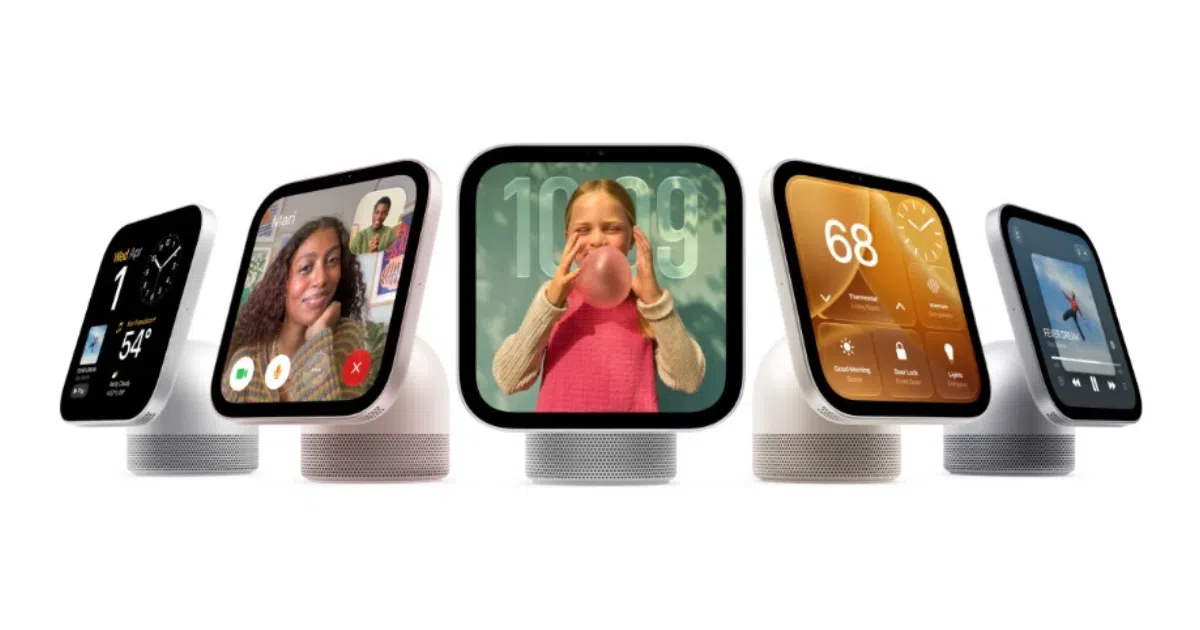
Apple HomeView reviews are out ahead of the November 13 release, and critics agree on the speaker and the design while faulting Siri AI and the thin app support. Engadget gave it 8.4 out of 10 and TechRadar and Stuff both scored it 4 out of 5, but Tom’s Guide says it can’t match what Amazon’s smart displays do.
The verdict depends on how much of your home already runs on Apple. Reviewers who live in Apple Home with an iPhone at hand call it the smart display to get, while others point to Echo Show models that start at $100 and handle more video and apps. The sections below go through six written reviews first and then five video reviews.

Engadget Gives HomeView an 8.4
Engadget’s Billy Steele gave HomeView 8.4 out of 10 and says it is more elegantly designed than any of its main rivals. He calls the sound a highlight, somewhere between a HomePod mini and a full-size HomePod, although the Dolby Atmos effect is modest.
His biggest complaint is that personal content depends on a nearby, recently unlocked iPhone or iPad. Without one, guests can still control smart home accessories, check the weather and play music. Video is weak because Apple TV is the only video app and it plays in a narrow band with black bars, while third-party apps only appear if they support CarPlay.
Recipes from Safari turn into step-by-step slides, but how well that works depends on how each recipe site formats its page, and poorly formatted pages show up as one long block of text. Steele recommends HomeView for iPhone households that want a Siri-driven hub, cooking help and FaceTime.
Tom’s Guide Says It Falls Short
Tom’s Guide’s Mike Prospero ran HomeView next to an Echo Show 15 with Alexa+ for a week and came away expecting more. He says it is built well and great at music, but it does less than Amazon’s smart displays, and he argues Siri is less capable than Alexa+ or Gemini.
Siri gave terse answers where Alexa+ was conversational. It could not order a pizza and only offered to place a call, while Alexa+ linked to Uber Eats, but it did better at searching his calendar and messages to find a neighbor’s party.
The Home Modular face cannot fit photos, weather and a front-door camera together the way an Echo Show 8 can. Several iPhone widgets, including Disney+, Eufy and YouTube, only show a message that the app is available on iPhone, and Apple TV is the only app that plays video natively. He also points out that there is no physical button to turn off the camera or microphone.
TechRadar Scores HomeView 4 of 5
TechRadar’s Jacob Krol spent eight days with the tabletop model in his kitchen and the wall-mounted model in his entryway, and scored HomeView 4 out of 5 for design, performance and value. He found the bass and volume strong enough that he sometimes used it as his main speaker, and the two units can be grouped.
The wall-mounted model has the same chip, display and camera but only the two drivers in the display, so it loses the down-firing woofer in the tabletop base and its low end is weaker. It also needs a separate mount, and you have to supply the power adapter.
Siri response times varied in his tests, with smart home requests taking about two seconds, weather two to three seconds, a music request about 12 seconds and multi-step requests 10 to 15 seconds. He tested it with Philips Hue lights, a Google Nest Learning Thermostat, an Eve Cam, a Eufy camera and Ryse Shades. HomeView supports Matter and Thread but has no native Zigbee, and he lists the missing App Store, shared calendar and motorized swivel as drawbacks.
CNN Underscored Flags the Price
CNN Underscored’s Mike Andronico spent a week with HomeView in his kitchen and says he would not spend his own $299 on it, but he enjoyed having it there for weather, FaceTime, music and Siri requests. He thinks it suits larger households with HomeKit cameras, lights and thermostats, where each person can have their own home screen.
He liked how Siri handled follow-up questions about the Knicks standings, the next game and where to stream it, and how it wrote a text message he could approve before sending. The speaker is loud and supports Spatial Audio, although the bass sometimes overpowered vocals, and the Home Modular face puts cameras, lights and the intercom on one screen.
The square screen is his main complaint, because at 7 inches it works for glancing at the weather and album art but not much else. Apple TV plays video in a tiny letterboxed window or a cropped 1:1 view, and there is no built-in Netflix, Disney+ or YouTube. He also notes that the $200 Echo Show 8 and $250 Echo Show 11 both have bigger screens for less money.
Gear Patrol Likes the Photo Frame
Gear Patrol’s Tucker Bowe tested HomeView for about a week and a half and calls it a great but pricey smart display for people deep in Apple’s ecosystem. He says it feels like a big Apple Watch, and that “Hey Siri” works as it does on a HomePod.
Holding an iPhone near the screen moves music, podcasts and calls over, and the same handoff works for Safari articles and recipes. A Photos face shows pictures from iCloud Photos or shared albums that family members can add to, which he says makes HomeView a good digital picture frame.
He asked his brother and friends to try reading his messages or placing calls for him, and they could not, because personal content needs facial recognition plus a nearby iPhone or Apple Watch. He had only three HomeKit lights, so he could not fully test the smart home controls, and he misses Sonos and Apple Sports apps, though speakers can be grouped over AirPlay.
Stuff Praises Hardware, Faults Siri
Stuff’s Dan Grabham gave HomeView 4 out of 5 and says it will be a great product once the software catches up. He likes the aluminum hardware and how well Handoff moves music between his iPhone and the display, but finds Siri AI slow and still in beta. The speaker is decent, he says, but no replacement for a second-generation HomePod, an Echo Studio or a Sonos Era 100.
The software has several quirks, and turning on a light from the Home app brings up a full-screen pop-up that needs a second tap. Accessories in Control Center show no room names, and HomeView follows the iPhone’s explicit-content setting, so he had to switch his phone to clean to stop HomeView playing the explicit version of a song. Siri also fails on many radio stations, answered “play the news” with Fox News Radio on one try, and replies louder than the music volume.
He calls HomeView expensive next to Amazon’s Echo Show range, and the Apple TV 4K release on the same day does not change that view. He also thinks the wall-mounted model should cost less than the tabletop one, since it needs a separate mount and has no woofer, and he suggests $200.
The Verge Backs Apple Households
Jennifer Pattison Tuohy calls HomeView the best smart display she has used for controlling a smart home. The A18 chip makes live feeds from her security cameras appear instantly, and she mounted one in her mudroom to run good-night and good-morning scenes, although those scenes have to be built in the Home app on an iPhone.
Her privacy tests found a catch. She could keep reading her daughter’s text messages for up to 10 seconds after the daughter walked away, and Siri AI’s personal context requests were slow and sometimes timed out. Apps are limited to about 10 first-party ones plus CarPlay audio and video apps, and the Ring widget only tells her the app is unavailable.
She says HomeView is powerful enough to run a smart home and simple enough for anyone in it to use, but it needs an iPhone or iPad and works only with Apple Home or Matter accessories, so her Ring and Google Nest cameras and smart coffee machine do not work with it. If your home already runs on Apple Home, she says it is the smart display to get.
Joanna Stern Tests Family Recognition
Joanna Stern spent a week with HomeView in a busy household and tested it against three promises from Apple’s own ad, which were family recognition, smart home control and Siri AI. Her sons could not get HomeView to read her messages by imitating her, though it switched to their accounts quickly and respected parental controls.
Siri would not unlock doors or open the garage by voice, which she was told was for security. Apple told her that recognized users can already unlock locks and garage doors by tapping the screen, and that a software update next month will extend that to Siri AI. The same update will fix Siri wrongly telling her the device has no camera.
She likes the speaker, the recipe mode and using HomeView to control AirPlay speakers around the house, and she prefers it to an Echo Show because it shows no sponsored ads. Siri was her main problem, since it misheard requests, triggered other devices in the room and once spent three minutes stuck on a math question. She says the hardware is good and is waiting for the software to catch up.
Brian Tong Is Torn on $299
Brian Tong tested HomeView at home, where he already runs Amazon and Google devices alongside Apple ones, and says it is cute and fun but a hard sell at $299 for someone with an established smart home. He found the speaker sounds good for its size, especially for podcasts, and the Home Modular face with a door lock and lights was the most useful screen.
Recipe mode turned a peach cobbler page into an ingredient list and step-by-step screens, and he liked it enough to call it the feature that makes HomeView fun. Safari is slow and many sites feel cramped on the 7-inch screen, and video is poor, since YouTube plays in a small window and the Apple TV app only appears because it comes from his phone through CarPlay.
He thinks HomeView works best for someone starting a smart home from scratch or building a new home, and he plans to revisit it when the Apple Home Collection accessories arrive in December. The wall-mounted model costs the same $299, and the mounts add $59 to $129.
ShortCircuit Favors Bigger Homes
The ShortCircuit team tested HomeView with a colleague who runs his smart home through Home Assistant and shares selected devices with HomeKit. That setup worked, and he said HomeView looks like a better wall controller than the clunky, outdated-hardware options he had seen, so he plans to buy three.
Recipe mode worked on most recipe sites and falls back to a reader mode when a page is not formatted as a recipe. The facial recognition is not Face ID because it has no infrared depth sensing, so the team says it is less secure. Video playback is subpar, and the Center Stage camera kept following a person who moved six or seven feet to either side.
The team thinks HomeView suits larger homes more than small apartments, because the smart home controls matter most where there is more to control. At $299 they say it could replace a digital picture frame and a Bluetooth speaker, and they suggest giving it a year to see how Apple responds to feedback.
MKBHD Calls It a Skip
Marques Brownlee posted a first-impressions video after Apple’s October 13 home event and says he is not convinced. He notes that the $300 price sits above the $229 Google Nest Hub Max and the $179 Amazon Echo Hub, and he finds it odd that the wall-mounted model costs the same despite having no woofer and no included adapter.
He likes the fast account switching for up to six people, but the camera has no Face ID depth sensing and there is no voice recognition, so personal context only appears when HomeView sees you. The display looks decent at up to 500 nits and down to 0.3 nits, and the sound had good bass but a lower maximum volume than he expected. There is no battery and no App Store, and third-party apps only appear when they work through CarPlay.
He cannot name a group of buyers HomeView is ideal for, and he calls it a skip for most people while allowing that a second generation could be more convincing. The video is a first look rather than a full review.
Apple HomeView Reviews Share One Catch
HomeView needs a compatible iPhone or iPad running the latest software for setup and multiuser support, and for personal content such as messages and calendar. Siri AI is in beta on HomeView, and personal context requests need an Apple Intelligence iPhone or iPad with Siri AI turned on.
HomeView costs $299 for the tabletop model and $299 for the wall-mounted model, which comes in silver and space gray. The wall-mounted model ships without a mount, USB-C cable or power adapter, and the Schneider Home mounts start at $59.95. The tabletop model includes a USB-C cable and a power adapter.
HomeView goes on sale November 13 in the United States, Australia, Canada, India, New Zealand, Singapore, South Africa and the United Kingdom. It is not sold in the European Union, because Siri AI is currently unavailable in iOS there.